
Mitsuki Fukunaga

Independent project Agentic engineering 2026

Turning AI agents into
a delivery system.

I designed the task coordination, independent review and recovery mechanisms that turn a backlog into working software. I built the skills, scripts and hooks behind the workflow, and used it to develop Quoll, a Markdown editor for VS Code.

Getting code written was only the beginning.

Agents could stall, duplicate work or report success while a pull request was still open. The challenge was making delivery dependable without step-by-step prompting.

01 / The workflow

I set the direction.
The system carries the task.

One task moves from assignment to verified completion. A coordinator manages the run; separate agents build and review the change.

My role

Define the work and its boundaries

I own product intent, backlog priorities and the rules that govern the run.

  1. 01/next-todo

    Assign

    Validate the task, claim it and create an isolated workspace.

  2. 02/review-plan

    Plan

    Check the design and test strategy before complex work begins.

  3. 03TDD & testing

    Build

    Implement the change and prove the tests detect the intended behaviour.

  4. 04/review-cycle

    Review

    Review independently, validate findings, fix and retest.

  5. 05/merge-pr

    Merge

    Wait for passing checks, merge and update the task record.

  6. 06/next-todo

    Verify

    Confirm the merge, local sync and completed task record.

Verified complete Continue to the next task.

Blocked or unresolved Report the evidence back to me.

One task → one pull request. Simple, local changes skip the formal plan review. Reviewers can work in parallel.

02 / Design decisions

Trust comes from how
the work is checked.

The most useful parts of the system came from diagnosing failures and turning the lessons into repeatable controls.

01

Separate building
from reviewing.

Quality engineering
The risk

Tests pass, but miss the defect.

The check

Remove the fix. Does the test fail?

An agent can repeat its own assumptions in both code and tests. Independent review and deliberate breakage checks challenge those assumptions.
02

Make completion
an observable fact.

Systems design
The risk

“Done” — but the PR is still open.

The check

Verify the actual result.

An agent’s report can outpace the actual result. Completion depends on repository evidence, and the task stays active until its completion record is confirmed.

03

Protect work
during recovery.

Reliability engineering
The risk

A session stops responding.

The response

Read saved state. Check before acting.

Recovery checks whether an agent is still working before taking over. Sync and cleanup also protect unfinished local work, so finishing one task does not erase another.

03 / In practice

A workflow used
to build real software.

The delivery project

QuollMarkdown editing for VS Code.

View Quoll on GitHub

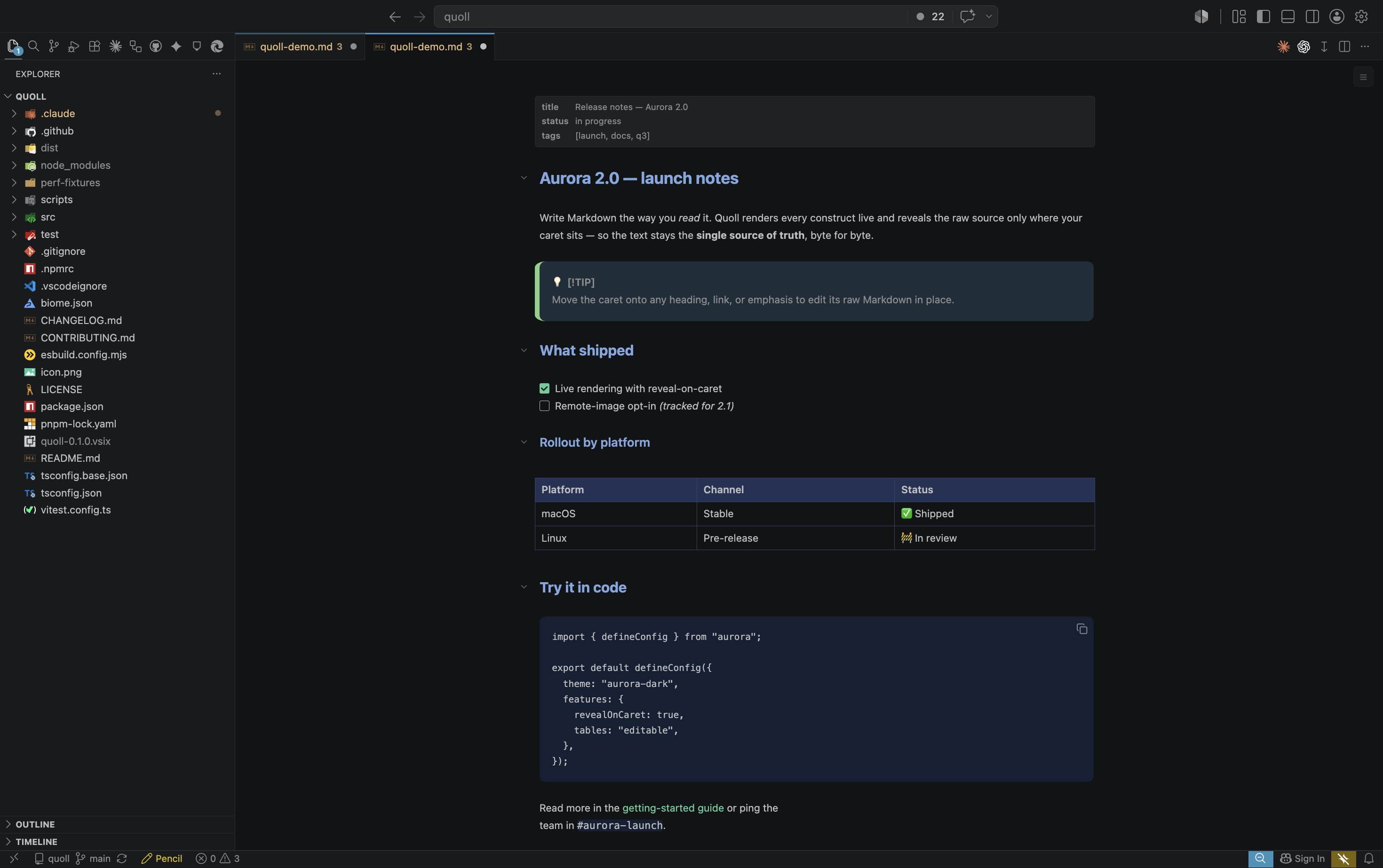
Quoll brings live-rendered Markdown, editable tables and task lists to VS Code. Agents wrote the code through this workflow; I designed and operated the delivery system.

The September 2026 snapshot recorded 387 merged pull requests in about two months. The example below shows how I checked the quality behind that activity.

Quality in practice

A test that proves it can catch the defect.

Merged · 19 August 2026
  1. The gap

    Existing tests checked selection logic in a simulated environment. They could not prove that a real pointer gesture worked inside the mounted editor.

  2. The change

    The task added Chromium tests that drag across table text and check the selected range, source reveal and editor focus.

  3. The evidence

    The PR records passing checks and deliberate breakage tests: disabling drag recognition made the drag tests fail. The tests could detect the regression they were meant to catch.

The review created the next improvement. It identified a repeated browser-timing helper. A separate follow-up consolidated it and verified that the affected tests used the shared implementation.

Quoll running inside VS Code, displaying formatted Markdown with headings, a callout, interactive task lists, a table and a code block.
Quoll inside VS Code. Select the image to view full size.Image source

The same approach supports my daily work.

This pipeline is part of a broader set of skills for knowledge work, daily operations and workflow improvement.

Knowledge

From
Notes, documents & meetings
To
Answers, summaries & study resources

Operations

From
Email, calendar & tasks
To
A morning brief & a triaged inbox

Collected data is also deduplicated and validated before an approved sync.

Continuous improvement

From
Incidents & review findings
To
Better skills & workflow rules

Workflow changes receive an external review.

04 / Under the hood

A closer look at the engineering.

What I built & what I built onCustom workflow components and the tools underneath
My contribution
Workflow design, the next-todo, review-plan, review-cycle and ship skills, and supporting scripts and hooks.
Built on
Claude Code, OpenAI Codex, Superpowers planning and TDD skills, cmux, Git worktrees and GitHub.
Operating scope
A personal system, improved through daily use and the failures it exposes.
Plan review & TDDCheck the approach, then prove the behaviour

/review-plan checks scope, dependencies and test quality. It records the reviewed version so later changes can be flagged.

TDDFailing test → implement → pass → refactor

Revert checkFix passes → remove the fix → test must fail

Test-driven development (TDD) helps guide implementation. My review rules focus on whether tests catch the defect; they do not require every change to follow a test-first sequence.

Recovery & human controlResume safely and return decisions to the right person

Hooks check for mistakes such as overwriting the shared task list or stopping while work is still running. Permission requests require human approval.

These controls address specific failures. Some only warn, and hook errors can let execution continue; a shared platform would need stronger enforcement.

Measurement notesWhat the figures cover

The Quoll project snapshot records 387 merged pull requests over about two months. It is separate from the broader platform usage snapshot below. These are activity figures; I have not measured a like-for-like manual development baseline.

39 skills · 7 hooks
Counted from source files on 10 September 2026.
208 sessions · 728 session hours
Claude Code usage data for 1 June–7 September 2026. Session hours are not hours of human work saved.
9,300+ commands · 318 commits
Agent-session activity in that same three-month window, not Quoll-only totals.

Connecting product intent
with dependable execution.

I bring product design and engineering together: turning a goal into an executable workflow, defining how quality is checked, and improving the system from real failures.

The next step is making it work beyond one operator. Before extending this to a shared platform, I would add formal evaluation datasets, versioned workflows with rollback, scoped service identities and audit trails.

My experience running AI-literacy sessions for non-technical teams also shapes that approach: people need to understand the system’s limits before they can confidently give it real work.